)
)
)
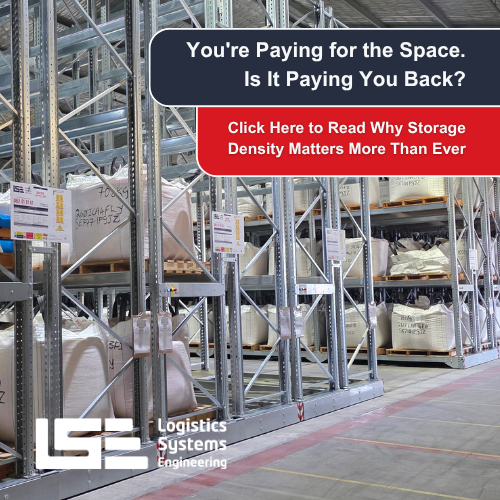
You’re Paying for the Space. Is it Paying you Back?
As Property, Energy and
Operational Costs Rise, Storage Density is Becoming a Business Decision. Not just
a Warehouse one.
For Years, Warehouse Growth followed a familiar formula:
More Stock requires More Pallet Positions. More Pallet Positions require More Floor Space. More Floor Space requires a Bigger Warehouse.
It sounds logical, but in today's Operating Environment, that Assumption deserves to be Challenged. When Warehouse Capacity starts Tightening, the Most Important Question isn't necessarily: "Where are we going to find more space?"
It may be: "Why aren't we getting more from the space we're already paying for?"
That distinction matters more than ever. The Challenge is that Poor Storage Density Rarely Presents itself as one Obvious Problem. Instead, it creates a Series of Hidden Bottlenecks across the Operation. From Property and Infrastructure Costs to Unproductive Aisle Space and, in Cold Storage, the Cost of Refrigerating Space that isn't Generating Storage Capacity.
Three of these Bottlenecks Deserve a Closer look.
1. The Cost Nobody Calls a Storage Cost
The Price of Poor Storage Density doesn't appear neatly on a Company's Financial Statements under "inefficient warehouse layout."
It hides elsewhere:
·
It can appear in Additional Property Costs.
·
Additional Refrigeration.
·
Longer Forklift Travel Distances
·
More Lighting.
·
More Infrastructure.
·
Additional Cleaning and Maintenance.
· Additional Facilities.
Which Results in an Expensive Warehouse Expansion that could have been Delayed, or Potentially Avoided, had the Existing Footprint been Better Optimised First.
Consider Property alone. Current Asking-Rental Data for Available Industrial and Warehouse Property in Cape Town shows an Average of Approximately R101/m² per month as at July 2026. At that Indicative Rate, an Additional 1,000 m² Represents More than R1.2 million in Annual Rental Cost before Considering the Operational Costs Associated with that Space.
Businesses should stop asking: "What does another 1,000 m² cost?"
They
should rather start asking: "What would it cost us if we didn't need it
in the first place?"
2. Are You Paying for Storage Space or Aisle Space?
Here's another Uncomfortable Question. Look across a Conventional Warehouse. How much of the Floor is Physically Storing Product? How much exists simply so Forklifts can Travel between Fixed Rows of Racking? Aisles are Necessary in Conventional Pallet-Racking Layouts, however Commercially, they are still Square Metres you're Paying for.
In a Cold Store, the Equation becomes even more interesting. Those Square Metres may also need to be Insulated, Refrigerated, Illuminated and Maintained, regardless of whether they're Holding Product.
That means the Real Measure of Warehouse Performance shouldn't simply be Pallets per Warehouse. It should Increasingly include Pallets per Square Metre, and in Temperature-Controlled Facilities, Cost Per Pallet Position Maintained at Temperature. Now Storage Density becomes a Financial Conversation, not Merely a Racking Conversation.
3. Cold Storage makes Wasted Capacity even Harder to Ignore
South Africa already has one of the Continent's Most Developed Cold-Chain Sectors, yet Food Loss remains a Significant Challenge. SA's Cold-Chain Market Estimates Approximately 10 Million Tons of Food Waste Annually, with Substantial Losses occurring during Post-Harvest, Processing, Packaging and Distribution Stages.
Across Africa, the Challenge Extends further. The United Nations Environment Programme (UNEP) continues to Identify Insufficient Cold-Chain Infrastructure as an Important Contributor to Food Loss and has Highlighted Cases where Improved Refrigerated Infrastructure Materially Reduced Post-Harvest Losses and Improved Farmers' Incomes.
Africa needs More Effective Cold-Chain Capacity, however Building More Refrigerated Volume is Capital Intensive. What if Part of the Opportunity isn't Simply Building More Cold Storage? What if it's making Existing and Future Cold Storage Denser? Every Cubic Metre brought down to Temperature should have a Job to do.
What does Better Storage Density actually Look Like?
Identifying the Bottleneck is one thing. Solving it without creating another is where Warehouse Design becomes Critical. Simply Fitting More Pallets into a Warehouse isn't the goal.
A High-Density Storage System still needs to Support Accessibility, Throughput, Stock Rotation, Safety and the Day-to-Day Operational Requirements of the Business. Increase Density at the Expense of those Factors, and you've simply Replaced a Space Problem with an Operational one.
The Real Objective should therefore be Maximum Useful Density. Creating More Storage Capacity from the Available Footprint while ensuring the Warehouse can still Perform the way the Operation requires. This is where the Storage System you choose can Fundamentally Change what your Existing Footprint is Capable of.
This is Where LSE's MovoRack Changes the Equation
MovoRack is Logistics Systems Engineering's (LSE's) Mobile Racking System, Designed for Businesses that need to Increase Storage Density without Simply Accepting that More Capacity must mean More Floor Space.
Instead of Permanently Dedicating Valuable Warehouse Floor Space to Multiple Fixed Aisles, LSE’s MovoRack places Pallet Racking onto Electronically Controlled Mobile Bases. The Racking remains Compacted Together until Access is Required, at which point the Necessary Aisle is Opened.
The Principle is Simple: Why Permanently Allocate Valuable Floor Space to an Aisle that isn't Permanently being Used?
For Suitable Applications, this Allows a Significantly Greater Proportion of the Warehouse Footprint to be Dedicated to Storage while Maintaining Direct Access to Individual Pallets.
Suddenly, the question changes. Businesses can ask: "How Much More Storage Capacity could we create Inside the Warehouse we Already have?"
More Density, but Not at the Expense of Your Operation
LSE’s MovoRack isn't about Squeezing as much Racking as physically possible into a building. It's about Finding the Right Balance between Storage Density, Accessibility, Throughput, Safety and Operational Efficiency. Every Warehouse is Different. SKU Profiles Differ. Pallet Movements Differ. Temperature Requirements Differ. Growth Plans Differ.
That's why LSE looks Beyond the Number of Pallet Positions. We consider How the Operation needs to Function Today, What the Business is likely to Require Tomorrow, and How the Storage System can Support Both.
For the Right Application, LSE’s MovoRack can help Businesses make Dramatically Better Use of their Available Footprint, Particularly in Environments where Warehouse Space is Expensive and Every Refrigerated Cubic Metre carries an Ongoing Cost.
Square Metres Don't Tell the Whole Story
Storage Density should No Longer be Viewed Simply as a Warehouse Design Consideration. When it can Influence Property Requirements, Infrastructure, Refrigeration, Capacity and the Timing of Future Expansion, it becomes part of a Much Larger Investment Decision.
That's exactly why Businesses should Challenge the Assumption that Growth must Automatically require a Bigger Warehouse. Sometimes expansion will absolutely be necessary, but before making that Investment, there is one Question worth Answering: “Have we Truly Exhausted the Potential of the Warehouse we already have?”
At Logistics Systems Engineering (LSE), we help Businesses answer that question before they Commit to the next one. Whether the Right Storage Solution is LSE’s MovoRack, Pallet Shuttle, Conventional Pallet Racking, Warehouse Automation or a Combination of Storage Technologies, our Focus is on Designing a Storage Solution around the Operation, not Forcing the Operation around a Product.
The Objective isn't simply to Install more Racking. It's to make better Business use of the Space you're already paying for. Before you Invest in More Space, find out What your Existing Space could be Worth. Discover LSE's Mobile Racking System (MovoRack) and see what Smarter Storage Density could mean for your Operation.
📞 South African: 0861 61 61 61 | International: +27 11 425 1694
🌐 Visit our Website at www.mobileracking.co.za for More Information.
Move More. Store Smarter.
)

)
)

)
)

)
)
)
)